
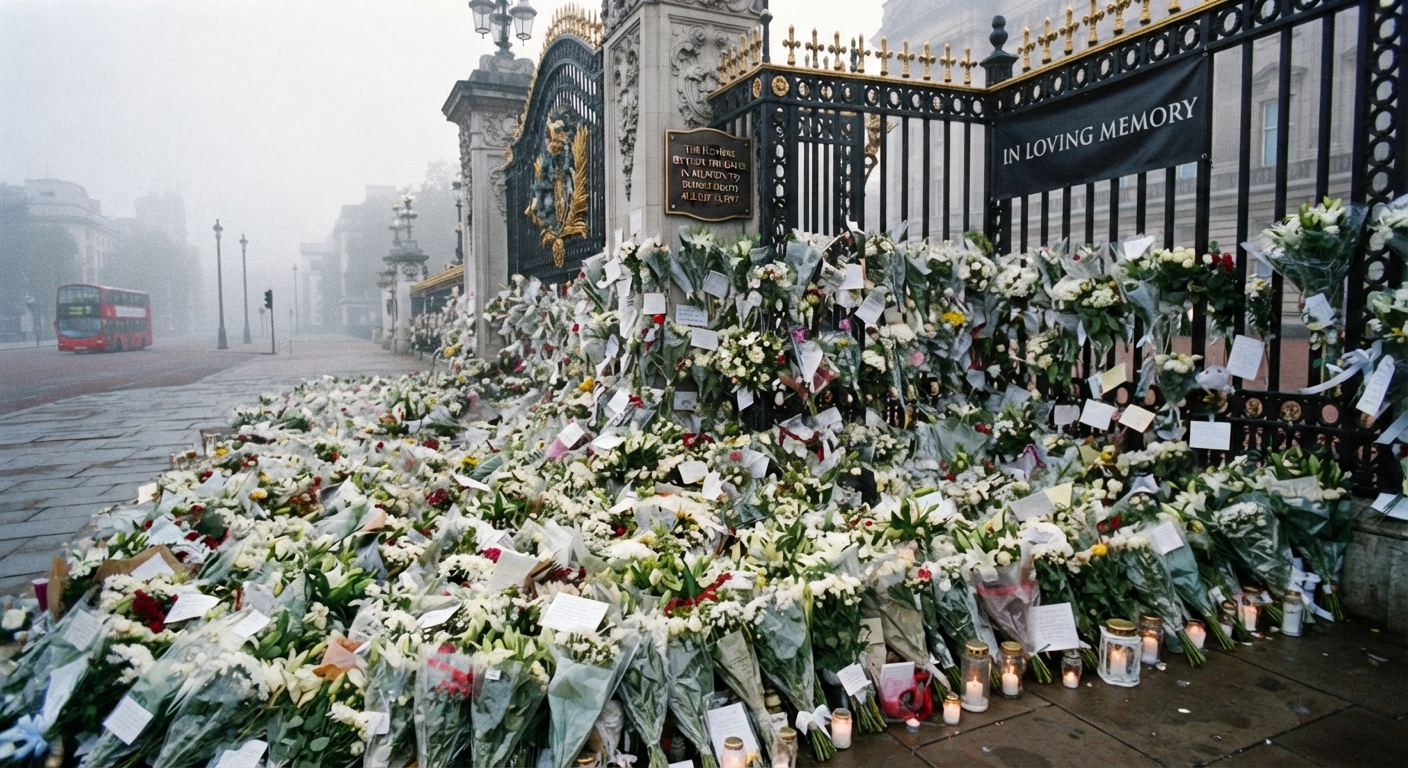
Almost everyone who was there mentions the flowers first. Not the flashbulbs, not the tears, not the strange hush that fell over a city more used to noise. The flowers. Banks of them piled six feet deep outside Kensington Palace, cellophane crinkling in the August heat, petals browning by the second morning before anyone had the heart to move them. It’s an odd detail to carry out of a week defined by shock and grief — and it’s exactly the kind of detail a news report has no room for, but a memory refuses to let go of.
In the early hours of August 31, 1997, Diana, Princess of Wales, died from injuries sustained in a car crash in the Pont de l’Alma tunnel in Paris. Her companion, Dodi Fayed, and the driver, Henri Paul, died at the scene. Her bodyguard, Trevor Rees-Jones, was the only person in the car to survive. She was 36 years old.
An estimated 2.5 billion people watched her funeral on September 6, 1997 — a number that’s been repeated in enough retrospectives that it risks becoming just a figure. But sit with someone who queued for hours outside St James’s Palace to sign a book of condolence, or who stood along the funeral route that morning, and the number stops being abstract. It becomes the specific silence that fell over a crowd of strangers as a single drumbeat carried down The Mall. It becomes two young boys, eight and fifteen years old, in an all too visible slow walk behind their mother’s coffin. It becomes a bouquet thrown from the crowd landing, unexpectedly, on the gun carriage itself.
The world that came after is one oral history remembers in its own way too — not through the iconic images, but through the smaller shifts that trace back to that week. A monarchy known for restraint delivered an unprecedented live address to the nation. A flag flew at half-mast over Buckingham Palace for the first time in its history, breaking a protocol no one had thought to question before. “The people’s princess,” a phrase coined almost in the moment, outlived the speech that produced it. And an industry built on chasing a single photograph was forced, at least for a while, to reckon publicly with what that chase had cost.
Why Oral History, And Why Now?
Every anniversary, the same handful of images resurface — the wrecked car, the flower-covered gates, two boys in matching dark suits. They’re powerful images, but repetition has worn them smooth. For readers born after 1997, they’ve become wallpaper: familiar, but not felt. Oral history exists to push back against that kind of flattening. It doesn’t settle for what happened. It asks what that week actually felt like from the inside, and — just as important — what it still feels like now, more than twenty-five years on.
That question was never only Britain’s to ask. People far from London remember exactly where they were when the news broke, exactly who told them, exactly how the rest of that day unfolded from thousands of miles outside a story the world seemed to assume belonged only to the UK. It’s a part of the memory that rarely makes it into the British-centered version of events — and it’s part of what a platform built outside that center is well placed to finally give room to.
The Voices Worth Centering
A few threads still sit underrepresented in mainstream retrospectives of that week — each substantial enough to carry its own future piece.
- Mourners who queued for hours outside Kensington and St James’s Palaces, and what standing shoulder to shoulder with strangers in that particular grief did to their sense of what a nation shares.
- Those who were children themselves in 1997, who grew up on the same looped footage of two young princes walking behind a coffin, and who mapped their own losses onto that image long before they understood it.
- Journalists and photographers working in that era, still weighing what the industry’s pursuit of one photograph cost, and how it did or didn’t change the practices that followed.
- Mourners outside Britain, especially across the Commonwealth, whose grief for a woman they never met is rarely treated as more than a footnote to the official story.
What Memory Carries That The News Never Could
Oral history, at its core, is a record of how memory ages. More than twenty-five years on, the people who lived through that week aren’t simply recalling an event anymore. They’re recalling who they were when it happened — and quietly measuring that person against who they’ve become since. That gap, between the moment and everything that came after it, may be the truest subject any oral history of Diana’s death can take on.
We hold the flowers and the flashbulbs in the same memory, because that’s what oral history asks of us: to keep both, gently, without letting either one erase the other.
In Remembrance
We remember Diana, Princess of Wales, whose life ended far too soon in a Paris tunnel on August 31, 1997.
We remember Dodi Fayed and Henri Paul, who died alongside her that night.
And more than twenty-five years later, we hold her sons, and everyone who loved her, in prayer — for comfort that outlasts the grief, and for peace that reaches every heart still carrying that week.
Gone, but never forgotten.
Have your own memory of that week, wherever you were in the world? Submit your story to be considered for a future feature on this site.