
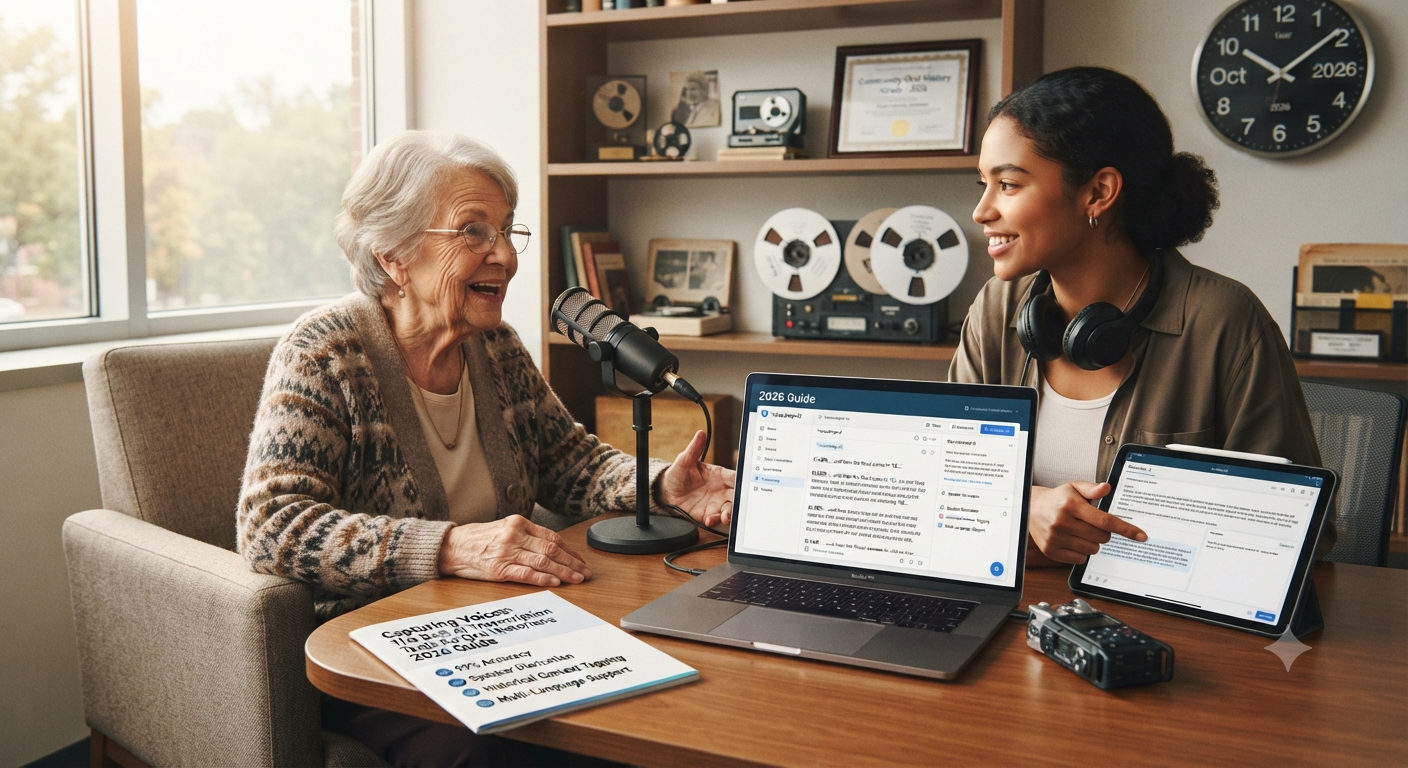
The reality of digital transcription hit home for me recently when a client sent over a 30-minute oral history interview that had been put through an automated AI bot. They reached out to me specifically because the transcript was essentially a wall of text—completely lacking speaker identification, and riddled with missing words that completely altered the meaning of the storyteller’s memories.
While it would have taken me roughly three hours to transcribe that audio from scratch and apply my usual rigorous editing standards, fixing that “AI-ready” file still took me about two hours. It was a stark reminder that while AI is a powerful assistant, it is not a replacement for the human ear. In the delicate field of oral history, where context, emotion, and cultural idiosyncrasies are paramount, AI often misses the subtle depth of the human story.
If you are looking to streamline your workflow without sacrificing the integrity of the stories you collect, here are the top AI tools available, along with a note on why the “human touch” remains indispensable.
OpenAI Whisper
Brief Descriptor: A powerful, open-source speech recognition model developed by OpenAI, widely considered the industry benchmark for raw transcription accuracy.
Why it excels: It is trained on 680,000 hours of audio, allowing it to handle diverse accents and technical vocabulary with incredible precision, achieving a Word Error Rate (WER) as low as 2.7%.
Technical Barrier: It is not a “plug-and-play” app; it generally requires some familiarity with Python to run on your local machine.
Caveat: It lacks built-in speaker identification and a user-friendly interface, serving as a raw engine rather than a finished product.
Pricing: The Whisper API is pay-as-you-go, costing approximately $0.006 per minute (or $0.36 per hour).
Hidden Costs: While the model is free, using the managed API involves costs for additional processing like speaker identification ($0.003–$0.01/min extra). If self-hosting, expect high “hidden” infrastructure costs including GPU instance rentals (starting ~$276/mo), maintenance, and DevOps time.
Happy Scribe
Brief Descriptor: A highly versatile transcription and subtitling platform that combines advanced AI models with optional human verification services.
Why it excels: It offers a robust hybrid workflow where you can use their AI to generate a base transcript and then utilize their human-review service for 99% accuracy.
Technical Barrier: There is no coding barrier, though the platform is feature-rich and may take time to master compared to simple recorders.
Caveat: The high-accuracy human-verified service comes at an additional cost, starting from $1.90–$2.00 per minute.
Pricing: Plans start with a free trial, while paid tiers range from $9/month (Lite) to $89/month (Business), plus pay-as-you-go options starting from $12/60 minutes.
Hidden Costs: “Human-made” services are billed separately and carry a premium per-minute price. Annual subscriptions lock you into a set amount of credits upfront, which may not align with fluctuating project volumes.
Sonix
Brief Descriptor: An automated transcription, translation, and subtitling platform focused on speed, ease of use, and professional collaboration features.
Why it excels: It is highly optimized for speed and provides a seamless, user-friendly interface that balances rapid processing with professional-grade accuracy.
Technical Barrier: None; it is designed for ease of use and requires almost no technical expertise.
Caveat: It relies on AI processing, which may still struggle with very muffled or low-quality historical recordings.
Pricing: Standard pay-as-you-go is $10/hour, or you can opt for a Premium subscription at $22/user/month plus $5/hour.
Hidden Costs: Specific advanced features or bulk subtitling exports may be restricted on lower-tier plans. Additionally, extra speakers or low-quality audio can lead to efficiency issues that indirectly cost you more time in manual cleanup.
Otter.ai
Brief Descriptor: A popular AI-powered meeting assistant designed to capture, transcribe, and summarize live conversations in real-time.
Why it excels: It integrates directly into calendar and meeting platforms to provide real-time, searchable notes and automated keyword extraction.
Technical Barrier: None; it is essentially “set it and forget it” simplicity.
Caveat: Accuracy typically ranges between 85% and 95%, often failing to capture the level of precision required for formal oral history archives.
Pricing: Offers a free Basic plan (300 mins/month). Paid plans include Pro ($16.99/month or $8.33/month billed annually) and Business ($30/month or $19.99/month billed annually).
Hidden Costs: The “Free” plan has severe limitations: a 30-minute per-conversation cap and a lifetime limit of only 3 file imports. Accessing “unlimited” usage or advanced features forces you into recurring monthly/annual subscriptions.
Quick Comparison at a Glance
| Tool | Pricing Model | Standout Accuracy |
| Whisper | ~$0.006/min (API) | ~97% (Clean audio) |
| Happy Scribe | $9–$89/mo (+ optional human add-on) | Up to 99% (with human review) |
| Sonix | $10/hr or $22/mo + $5/hr | Up to 99% |
| Otter.ai | Free or $8.33–$30/mo | ~85–95% |
A Note on Oral History Transcription
We highly recommend using these tools to generate your initial draft, but it is essential to have a professional human transcriber perform the final polish to ensure the integrity and spirit of the narrative are preserved. If you need expert, high-touch transcription that captures the heart of your project, JoFranLu Oral History & Transcription Services is exactly the place to ensure your history is handled with the care it deserves.