
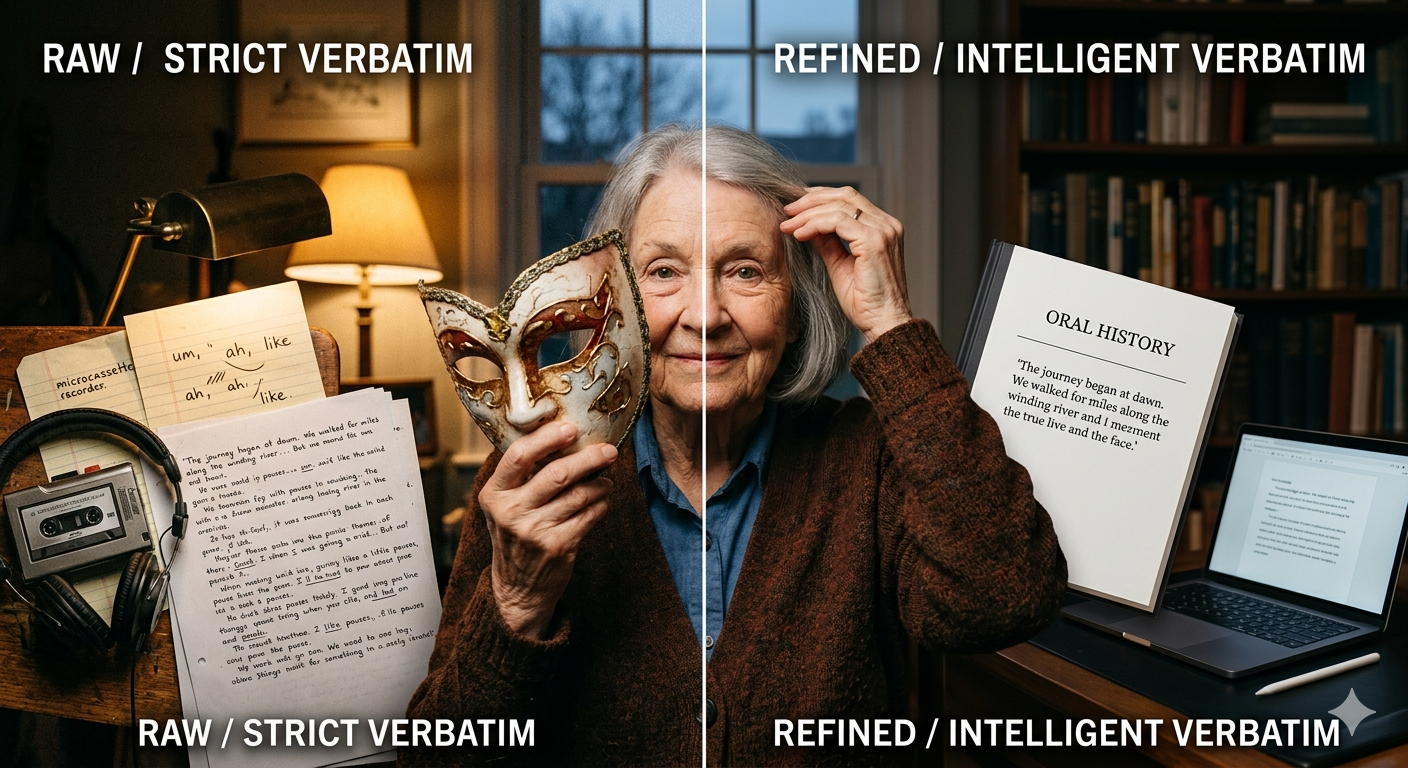
Preserving a life story is an act of love, but the technical side of oral history often presents a difficult crossroads. When you sit down to turn hours of recorded conversation into a written document, you are faced with a pivotal design choice: Intelligent Verbatim or Strict Verbatim.
The path you choose will fundamentally change how future generations experience those memories. Here is how to decide which style honors your project’s mission.
- Strict Verbatim: The “Raw” Lens
Strict verbatim is the “warts and all” approach. It captures every single sound uttered during the interview. This includes:
- Fillers: “Um,” “ah,” “uh-huh.”
- Stutters and False Starts: “I—I went to the—we actually went to the store.”
- Non-Verbal Cues: [Laughs], [Sighs], [Clears throat].
- Idiosyncrasies: Slang, “gonna,” “wanna,” and repetitive “you knows.”
Why choose it?
This style is the gold standard for legal or academic research. If you are analyzing a narrator’s speech patterns, emotional state, or linguistic habits, you need every breath captured. It provides the most “accurate” record of exactly how the person sounded in that moment.
- Intelligent Verbatim: The “Polished” Lens
Also known as “Clean Verbatim,” this style focuses on the substance of the story. The goal is to remove the distractions of natural speech without changing the meaning. In this version, fillers and “umms” are edited out, and false starts are smoothed over.
Why choose it?
This is often the best choice for family legacies and public-facing projects. Most people do not realize how much they stutter or use fillers until they see it in print. Strict verbatim can sometimes make an intelligent person appear incoherent or difficult to follow. Intelligent verbatim ensures the reader stays focused on the message and the memory, rather than the mechanics of the speech.
Which One is Right for Your Project?
| Feature | Strict Verbatim | Intelligent Verbatim |
| Primary Goal | Clinical Accuracy | Readability & Flow |
| Best For | Courtrooms, PhD Research | Family Books, Blogs, Memoirs |
| Tone | Authentic, sometimes cluttered | Professional, clear, and direct |
| Effort | High (Detail-oriented) | High (Requires editorial judgment |
The Designer’s Dilemma
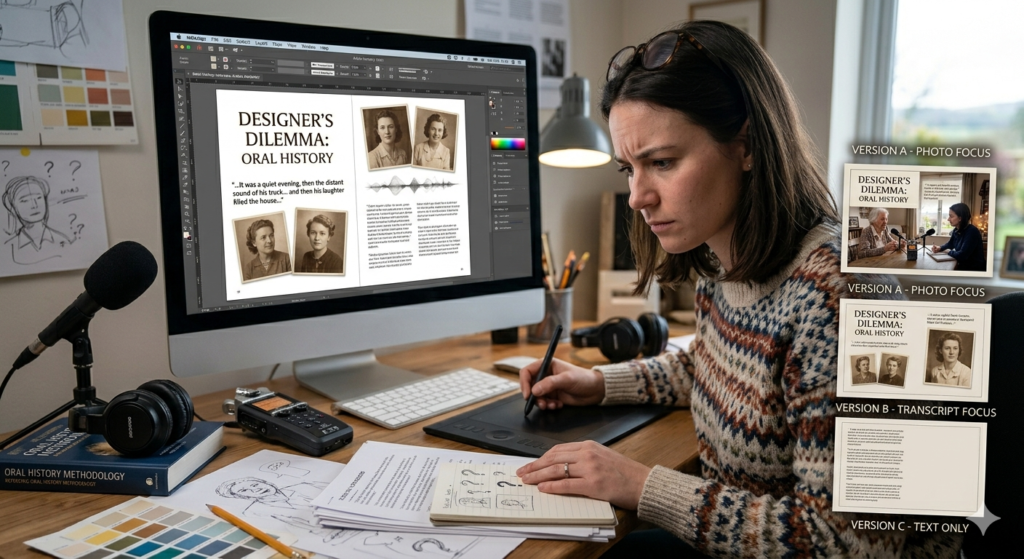
Ultimately, designing an oral history project is about balancing fidelity with empathy. Ask yourself: Who is the audience? If the audience is a great-grandchild, they might prefer a readable story. If the audience is a historian, they might prefer the raw data.
Regardless of your choice, remember that the most important thing is that the voice is preserved.
Ready to dive deeper into the nuances of transcription?
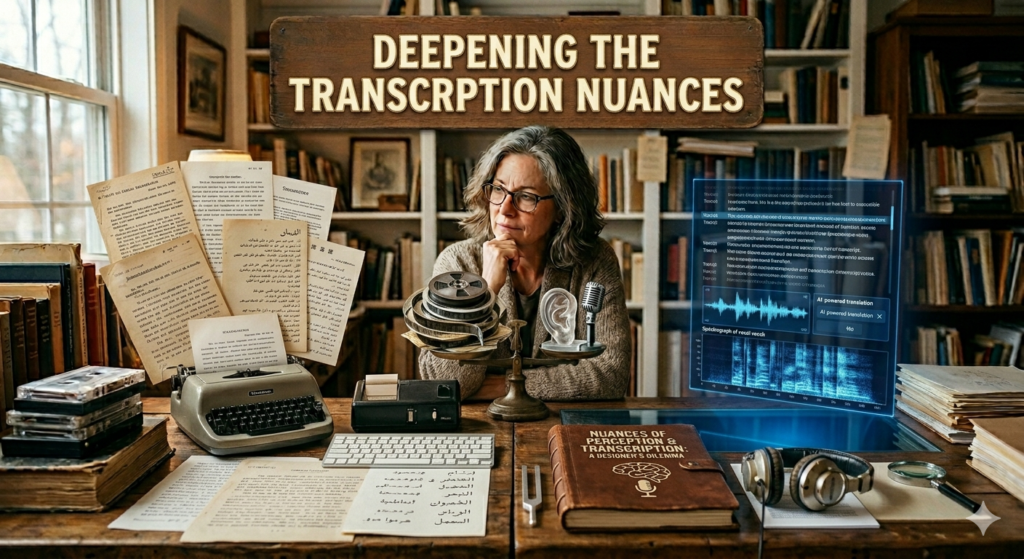
If you want to learn how to keep the “feeling” of a conversation alive without the clutter, be sure to check out my other post Beyond the Words: Capturing the Soundscape of Memory in Clean Verbatim Oral History.
Have a question or a project in mind? We’d love to help bring your oral history to life. Feel free to reach out, and we’ll get back to you soon. In the meantime, remember to be kind, stay positive, and take a moment to unwind.